
Uma boa leitura de VSWR indica que a porta da antena está bem combinada com a linha de alimentação. Isso é útil, mas é apenas parte do quadro. O VSWR não mostra se a antena realmente envia energia na direção certa, com a força certa, através da área de cobertura que você precisa. Para responder a essas perguntas, você precisa de medições de radiação feitas em um ambiente controlado. É aí que entra nossa câmara anecóica de microondas.
O que é uma Câmara Anecóica de Microondas?
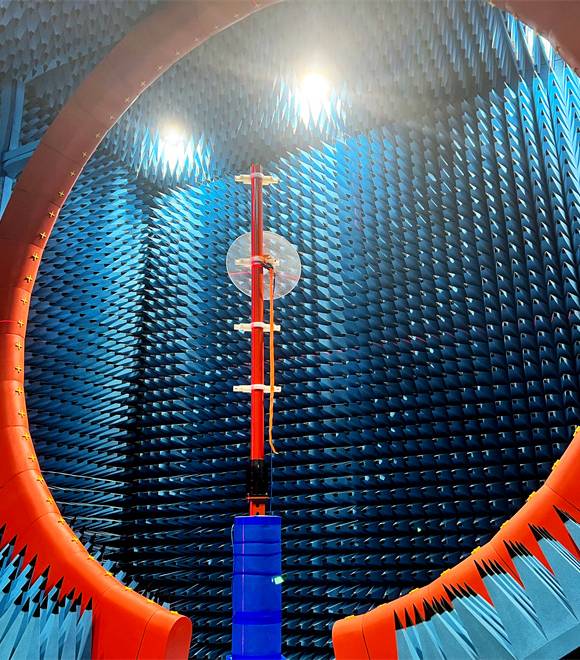
Uma câmara anecóica de microondas é uma sala blindada cujas paredes, piso e teto são forrados com material absorvedor de RF. Os absorvedores reduzem os reflexos das superfícies da sala e a blindagem bloqueia a interferência de RF externa. Juntos, esses recursos criam um ambiente de medição controlado que se aproxima das condições de espaço livre.
Dentro da câmara, a antena sob teste (AUT) é montada em um dispositivo de posicionamento. Uma antena de referência na extremidade oposta transmite ou recebe um sinal conhecido. Ao girar o AUT e registrar a potência recebida em cada ângulo, o sistema produz um padrão de radiação e uma medição de ganho que seriam difíceis de obter com confiabilidade em um ambiente aberto com reflexões, caminhos múltiplos e fontes de interferência próximas.
Como a BBT ANTENNAS Testa Antenas
Nosso processo de teste de antena segue três estágios. O objetivo em cada estágio é comparar as medições reais com os requisitos de RF que ambos os lados acordaram no início do projeto.
- Revisar os requisitos mecânicos e de RF acordados. Antes de qualquer medição, confirmamos as bandas de frequência alvo, ganho, forma do padrão de radiação, limite de VSWR, tipo de conector e restrições mecânicas com o comprador. Esses alvos acordados se tornam a referência de aprovação/reprovação para o teste.
- Verificar o VSWR / S11 com um VNA, depois medir o ganho e o padrão de radiação na câmara. O VSWR e a perda de retorno são verificados usando um analisador de rede vetorial (VNA), que nos diz o quão bem a porta da antena corresponde à linha de alimentação em toda a banda operacional. O ganho e o padrão de radiação são então medidos dentro da câmara anecóica de microondas. A posição de montagem do AUT, a orientação e a configuração do dispositivo afetam os resultados, por isso os definimos para corresponder à condição de instalação pretendida o mais próximo possível da prática.
- Comparar a amostra com as metas acordadas e revisar se ajustes são necessários. Comparamos os dados medidos de VSWR, ganho e padrão com os requisitos do primeiro estágio. Se um parâmetro estiver fora do alvo, a equipe de engenharia analisa se um ajuste no design da antena, uma mudança no dispositivo ou um novo teste são necessários antes que o projeto passe para a próxima fase.
O Que os Resultados do Teste Dizem a um Comprador OEM ou ODM
Cada medição responde a uma pergunta diferente sobre o desempenho da antena. A tabela abaixo resume as três medições que a BBT ANTENNAS fornece e por que cada uma é importante para a decisão de um projeto.
| Medição | O que mostra | Por que importa |
|---|---|---|
| VSWR / perda de retorno | O quão bem a porta da antena corresponde à linha de alimentação na banda de operação. Um VSWR mais baixo significa que menos sinal é refletido de volta. | A má correspondência de portas desperdiça a potência de transmissão e pode degradar a sensibilidade do receptor. O VSWR é um indicador de nível de porta e não descreve como a antena irradia. |
| Ganho | Quanta força de sinal a antena adiciona (ou perde) em sua direção de pico em comparação com uma referência. | Ganho determines whether the antenna can deliver the link budget your system needs at the required distance. Measured in the chamber to remove environmental interference. |
| Padrão de radiação | Como a antena distribui a energia irradiada no espaço, geralmente mostrada como um gráfico polar ou retangular em ângulos de azimute e elevação. | O padrão mostra se a cobertura corresponde ao seu cenário de instalação: amplo para aplicações omni, estreito para links ponto a ponto ou moldado para cobertura de setor. |
VSWR confirms that the signal enters the antenna efficiently. Ganho and radiation pattern confirm that the signal leaves the antenna in the right direction and at the right strength. A complete evaluation needs both sides of that picture.
Por que Apenas o VSWR Não é Suficiente
O VSWR responde a uma pergunta: quanto do sinal de entrada entra na antena em comparação com quanto é refletido de volta. É uma medição de correspondência de portas. Não diz para onde a energia vai depois de entrar na antena, ou quanto dela atinge a área de cobertura pretendida.
Uma antena pode exibir um VSWR abaixo de 1.5:1 em toda a banda de operação e ainda fornecer baixo ganho ou um padrão que aponta para a direção errada. A energia pode ser absorvida em perdas, irradiada em uma direção indesejada ou espalhada de forma muito ampla para ser útil. Sem uma medição de ganho e um padrão de radiação de um ambiente de câmara controlada, um resultado de VSWR de aprovação pode dar falsa confiança em um design que na verdade não tem um bom desempenho.
É por isso que nosso sistema de teste de antenas inclui verificações no nível da porta (VSWR/S11 no VNA) e medições de radiação (ganho e padrão na câmara anecóica). Juntos, eles dão uma imagem mais completa de se a antena atende aos requisitos do projeto.
Como os Dados do Teste Apoiam o Desenvolvimento de Antenas Personalizadas
Para projetos de antenas OEM, ODM e personalizados, os dados de teste em câmara desempenham um papel específico no estágio de avaliação de amostra.
- Confirmação de requisitos. Antes do teste, os dois lados concordam com os alvos de RF: bandas, ganho, forma do padrão, limite do VSWR. Os dados do teste são então comparados diretamente com esses alvos.
- Comparação de amostra. Se uma amostra de protótipo não tiver ganho suficiente ou apresentar uma forma de padrão inesperada, os dados ajudam a equipe de engenharia a identificar onde o design precisa de ajustes. Em vez de adivinhar, a equipe pode trabalhar a partir de evidências medidas.
- Revisão do design antes da produção. Ajustar um design de antena no estágio de protótipo é muito menos caro do que descobrir um problema de desempenho após a produção em volume. O teste em câmara fornece um ponto de verificação entre a aprovação da amostra e a produção em massa.
Nem todo projeto segue uma sequência de testes idêntica. O escopo do teste depende do que foi acordado para cada projeto. Para ver mais de perto como a BBT ANTENNAS lida com projetos de antenas personalizadas desde o requisito até a entrega, veja nosso(a) design de antena personalizado e serviços OEM/ODM página. Para detalhes sobre fábrica, qualidade e produção, veja nossas capacidades de fabricação de antenas.
O Que Enviar Para um Teste de Antena ou Projeto Personalizado
Se você estiver se preparando para discutir um teste de antena, design personalizado ou projeto OEM/ODM, ter os seguintes detalhes prontos nos ajudará a dar uma resposta clara e específica:
- ▪ Bandas de operação (faixa de frequência ou canais específicos)
- ▪ Ganho alvo (dBi, com direção se aplicável)
- ▪ Cobertura ou padrão de radiação necessários (omni, setorial, direcional ou uma largura de feixe específica)
- ▪ Dimensões da antena (restrições de tamanho ou formato)
- ▪ Conector e cabo (tipo, comprimento e posição)
- ▪ Condição de montagem (poste, parede, teto, PCB ou gabinete)
- ▪ Ambiente de instalação (interno, externo, veículo, industrial, marinho)
- ▪ Quantidade esperada (amostra, lote piloto ou volume de produção)
Quanto mais completos forem os seus dados, mais rápido poderemos confirmar se um design existente se encaixa ou se um novo design é necessário e quais testes serão incluídos.
Perguntas Frequentes
Para que é usada uma câmara anecóica de microondas?
Uma câmara anecóica de microondas é uma sala blindada revestida com material absorvedor de RF. Ela reduz reflexões e bloqueia interferências externas para que as medições da antena, como ganho e padrão de radiação, possam ser feitas em um ambiente controlado que se aproxima das condições de espaço livre.
Quais medições de antena a BBT ANTENNAS pode fornecer?
BBT ANTENNAS measures VSWR and return loss with a vector network analyzer, and measures gain and radiation pattern in the company's in-house microwave anechoic chamber. These three measurements cover port matching, signal strength in the intended direction, and how energy distributes around the antenna.
O teste em câmara anecóica é o mesmo que o teste de conformidade EMI/EMC?
Não. O teste de antenas em uma câmara anecóica concentra-se no desempenho de RF pretendido: ganho, padrão de radiação e correspondência de portas. O teste de conformidade EMI/EMC concentra-se em emissões não intencionais e imunidade a interferências externas. Os dois servem a propósitos diferentes e seguem procedimentos diferentes.
Por que o teste VSWR não é suficiente por si só?
O VSWR mostra o quão bem a porta da antena corresponde à linha de alimentação, mas não revela como a antena irradia energia para o espaço. Uma antena pode apresentar bom VSWR, mas fornecer ganho baixo ou um padrão de radiação inutilizável. As medições de radiação baseadas em câmara preenchem essa lacuna.
Como os testes em câmara apoiam um projeto de antena OEM ou ODM?
O teste em câmara permite que a equipe de engenharia compare uma amostra de protótipo com os alvos de RF acordados antes da produção. Se ganho, padrão ou VSWR caírem fora da exigência, o design pode ser ajustado e retestado. Essa etapa de verificação reduz o risco de descobrir problemas de desempenho após o início da produção em volume.
Discuta os Requisitos do Teste da Sua Antena
Envie-nos as suas bandas de operação, ganho alvo, padrão de radiação ou requisitos de cobertura, dimensões da antena, conector, ambiente de montagem e quantidade esperada. Confirmaremos o escopo do teste e as próximas etapas do seu projeto.
Envie os Requisitos da Sua Antena